

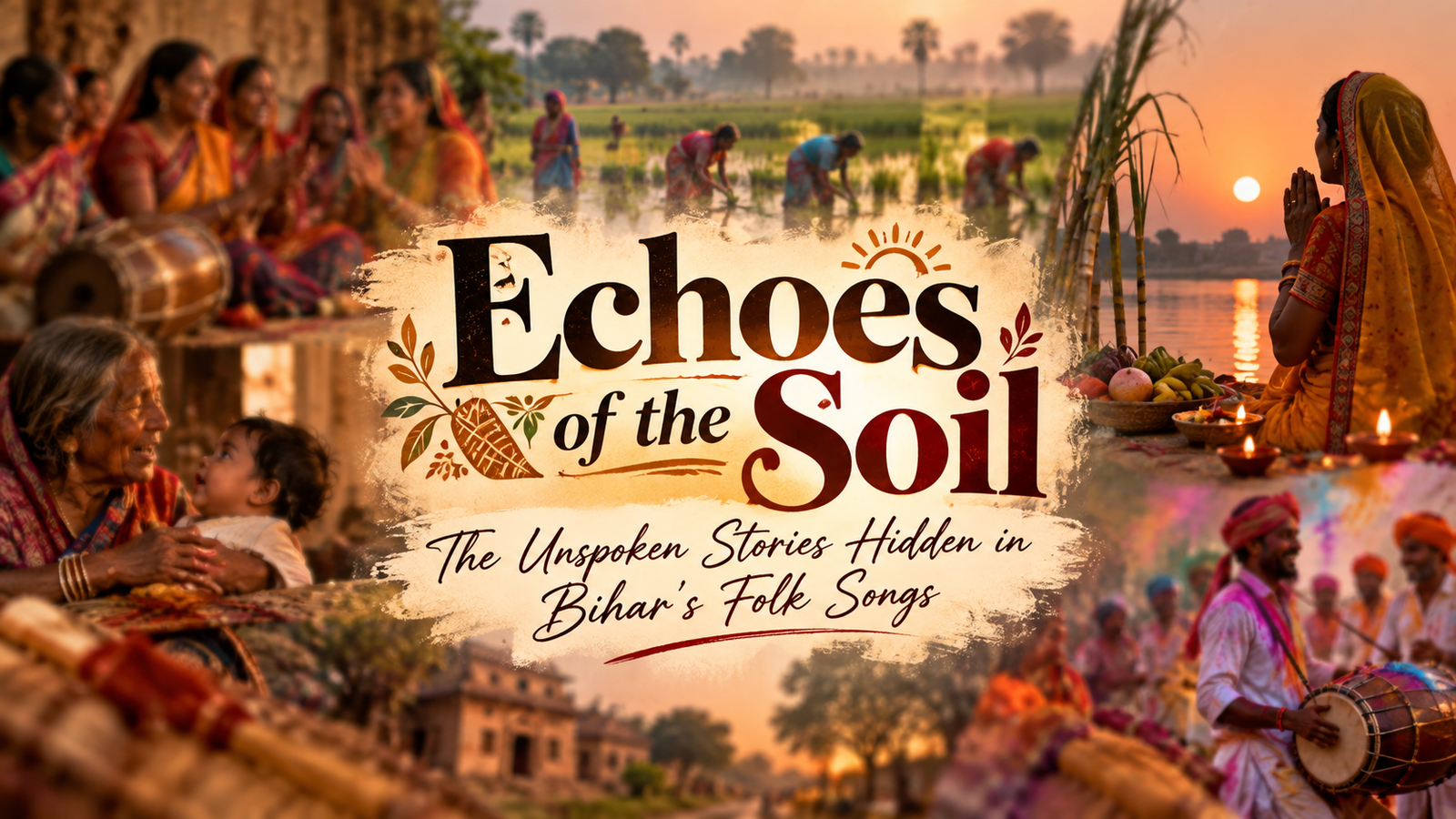
From the first cry of a newborn to the pain of migration, Bihar’s folk songs carry the memories, emotions, and traditions of generations.
If you have ever spent an evening in Bihar as the sun slowly dips below the horizon, you may notice something special: the land does not simply become quiet ,it begins to sing.
The rhythm of Bihar is not found only in polished studio recordings or modern music. It lives in the voices of grandmothers sitting in courtyards, in the synchronized singing of women working in paddy fields, in wedding celebrations filled with laughter, and in the gentle songs sung beside a child’s cradle.
Bihar’s folk music is more than melody. It is a living diary of its people. Every important moment birth, marriage, harvest, devotion, celebration, separation, and longing has its own musical expression.
These songs tell stories that are often never written down. They preserve memories, traditions, emotions, and ways of life that have travelled from one generation to another.
The First Cry: Joy and Blessings in Sohar
For many traditional communities in Bihar, the journey of life begins with Sohar.
When a child is born, the household fills with happiness. Instead of keeping this joy private, family members and women from the community gather together and sing. Sohar songs celebrate the newborn, bless the mother and child, and express hopes for a happy future.
But Sohar is more than a celebration of birth. It is also a form of cultural memory. Through these songs, older generations pass their traditions and values to younger ones.
The first chapter of life, therefore, is not silent. It begins with a song.
Love, Laughter and Rituals: Bihar’s Wedding Songs
If birth begins with Sohar, marriage brings an entire collection of songs.
A traditional Bihari wedding is filled with music from playful songs during ceremonies such as Haldi to more devotional and emotional Vivah Geet. These songs capture the many emotions surrounding marriage: excitement, nervousness, love, humour, separation, and the joining of two families.
Some songs playfully tease the bride, groom, or their relatives. Others express the emotions of parents as their daughter prepares to leave her home.
In this way, wedding songs do something remarkable: they turn a social ceremony into a story.
They also help preserve traditions. A song learned from a grandmother may be sung by a granddaughter decades later, carrying a piece of the past into the present.
When the Fields Sing: Ropni and Katni
Bihar’s folk music does not belong only to homes and celebrations. It also belongs to the fields.
During the agricultural seasons, Ropni (paddy sowing) and Katni (harvesting/reaping) songs become part of rural life. Farmers working together in the fields sing collectively while performing physically demanding work.
Imagine a group of people working under the sun, surrounded by green fields, mud, water, and crops. Their voices rise together, transforming labour into a shared experience.
These songs can express hopes for good rainfall, gratitude towards nature, humour, love, and the everyday struggles of rural life.
The song does not remove the hard work but it makes the work feel lighter.
The field becomes a stage, and the workers become its singers.
From Birth to Harvest: A Musical Journey Through Life
Bihar’s folk traditions can almost be understood as a musical map of human life:
Birth → Sohar → Marriage → Vivah Geet → Agriculture → Ropni/Katni → Devotion → Chhath Geet
Each song belongs to a particular moment, but together they tell one larger story the story of a community and its relationship with life, family, work, and nature.
When the Sun Becomes Sacred: Chhath Songs
No discussion of Bihar’s folk culture feels complete without mentioning Chhath Puja.
As the sun begins to set and devotees gather near rivers, ponds, and other water bodies, the atmosphere becomes deeply spiritual. Alongside the rituals, Chhath songs fill the surroundings with devotion.
These songs express gratitude to the Sun, nature, family, and life itself. Their emotional power comes partly from their simplicity: they connect ordinary people with something larger than themselves.
For many Biharis, Chhath is not simply a festival. It is an emotional connection to home, family, tradition, and nature.
And the songs make that connection audible.
Colours of Togetherness: Phagua and Hori
Then comes spring and with it, a completely different mood.
During Holi, Phagua and Hori songs bring colour, humour, teasing, dancing, and laughter into public spaces. The seriousness of everyday life temporarily gives way to celebration.
People sing together, tease one another, and participate in a shared cultural experience.
These songs remind us that folk music is not always about preserving solemn traditions. Sometimes, it is simply about being together and enjoying the moment.
The Ache of Absence: Biraha and Udasi
But Bihar’s songs also carry pain.
For generations, migration has been an important part of life in Bihar. People have often had to leave their villages and families in search of education, work, or a better future.
And when someone leaves, someone is left behind.
This is where traditions such as Biraha and Udasi give voice to emotions that are difficult to express in ordinary conversation.
They speak of separation, loneliness, homesickness, and longing the pain of a loved one waiting at home or a migrant remembering the soil they left behind.
These songs remind us that migration is not only an economic story. It is also an emotional story.
Every person who leaves carries a piece of home with them, while every person who waits carries the memory of the one who left.
More Than Songs: Bihar’s Living Memory
Bihar’s folk songs are not simply old pieces of music preserved in museums or history books. They continue to live wherever people gather, celebrate, work, pray, remember, and mourn.
A Sohar remembers the beginning of life.
A Vivah Geet remembers the joining of families.
A Ropni or Katni song remembers the relationship between people and the land.
A Chhath song expresses gratitude towards nature.
A Phagua celebrates togetherness.
And Biraha remembers the pain of separation.
Together, they form something much larger than music.
They form the emotional soundtrack of Bihar.
Perhaps that is why these songs remain so powerful. They tell us where we come from, what our communities value, what we celebrate, and what we miss.
And when the voices of one generation are carried by the next, the soil itself seems to remember.
Bihar does not merely preserve its stories in books.
It sings them.